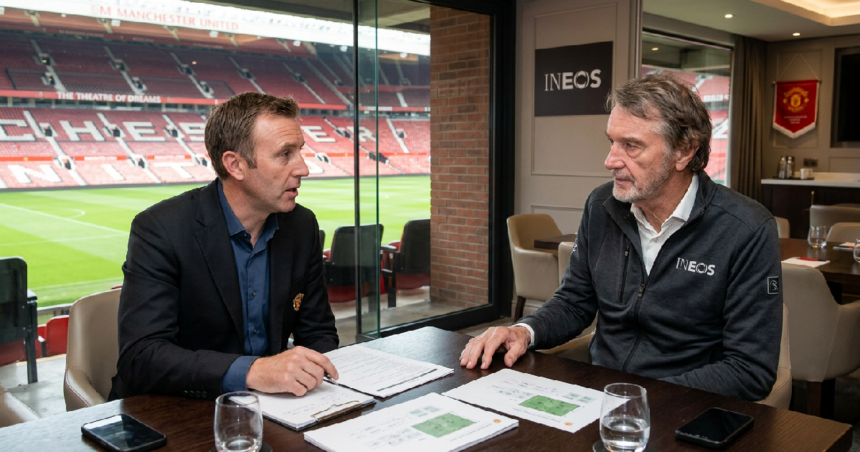
The honeymoon period at Manchester United following Sir Jim Ratcliffe’s partial takeover appears to be giving way to the harsh realities of a complex boardroom restructure. Tension is mounting at Old Trafford as Ratcliffe and Technical Director Jason Wilcox have reportedly reached an impasse over the profile of the club’s next head coach.
Since INEOS assumed control of football operations, the mantra has been one of “best-in-class” appointments. However, the first major philosophical rift has emerged between the billionaire owner and his hand-picked recruitment specialist. While the hierarchy remains officially tight-lipped about Erik ten Hag’s long-term job security, the active search for a potential successor has exposed a disconnect in how the club should be managed from the dugout.
Wilcox favors tactical system over celebrity
Jason Wilcox arrived from Southampton with a reputation for establishing clear, identity-based frameworks. His vision for United is modeled on a rigorous tactical blueprint—a “game model” that dictates how every team from the academy to the first team operates. Sources close to the club suggest Wilcox is championing a coach who is a dedicated “training ground” specialist, someone capable of implementing a specific style of play regardless of their global profile.
This approach mirrors the successful structures seen at Manchester City and Arsenal, where the coach is a cog in a larger sporting machine. Wilcox is reportedly pushing for a candidate who fits this mold, prioritizing tactical flexibility and a track record of player development over a trophy-laden CV.
But that vision is clashing with Ratcliffe’s desire for a figurehead who can restore the club’s perceived aura. Ratcliffe is said to be leaning toward a more established, “elite” managerial name—a personality capable of commanding the dressing room through sheer status and previous success in Europe’s top five leagues.
Ratcliffe seeks a transformative leadership figure
Sir Jim Ratcliffe has been vocal about knocking rivals “off their perch,” and his preference for the bench reflects that ambition. For the INEOS founder, the appointment isn’t just about tactical drills; it’s about a culture shift. Ratcliffe reportedly believes the club needs a charismatic leader who can act as the face of the new era, someone who brings an immediate sense of authority to a squad that has struggled with consistency for years.
The friction lies in the power dynamic. If Ratcliffe overrules Wilcox to hire a “big name,” it risks undermining the very sporting structure he spent months building. Conversely, if Wilcox wins out and the “project coach” fails to deliver immediate results, the pressure on the board will be immense.
This internal debate comes at a sensitive time for the squad. As clubs shift strategy as the summer transfer window looms, United’s lack of a unified coaching vision could hamper their ability to land primary targets. Agents and prospective signings are reportedly seeking clarity on who will be leading the team come August.
The shadow of the existing regime
While the Ratcliffe-Wilcox debate rages, Erik ten Hag remains in the building, effectively working under a cloud of uncertainty. The delay in reaching a consensus between the owner and the technical director has slowed the process of a definitive decision on the Dutchman’s future.
For many observers, this feels like an old Manchester United problem in new clothes. The club has spent a decade vacillating between “project” managers like Louis van Gaal and “personality” managers like Jose Mourinho, never quite committing to a singular philosophy. The current clash suggests that even with new investment, the fundamental question of what a Manchester United manager should be remains unanswered.
The coming weeks will be telling. If United move for a high-profile free agent, it will be seen as a victory for Ratcliffe’s “big picture” approach. If they pivot toward a rising star from the Bundesliga or Eredivisie, Wilcox’s influence will be confirmed. For now, the two most powerful men in the football department are locked in a game of professional chess.
Frequently Asked Questions
Is Erik ten Hag definitely leaving Manchester United?
No official announcement has been made, and the manager continues to oversee first-team duties. However, the reported search for a successor and the disagreements over coach profiles indicate that the board is seriously considering a change before the next season begins.
Why is Jason Wilcox’s opinion so influential?
Wilcox was brought in specifically to oversee the “footballing identity” of the club. His role is to ensure that the team plays a consistent style of football that is sustainable long-term. Overruling him this early in his tenure could damage the integrity of the new sporting department Ratcliffe has built.
What kind of managers is Sir Jim Ratcliffe looking for?
Ratcliffe reportedly favors “serial winners”—coaches with a proven track record of handling high-pressure environments at the world’s biggest clubs. He views the manager as a vital component of the club’s commercial and competitive brand, rather than just a tactical instructor.